
In the Beginning
Note: I started this in 2019. Some references are pretty old.
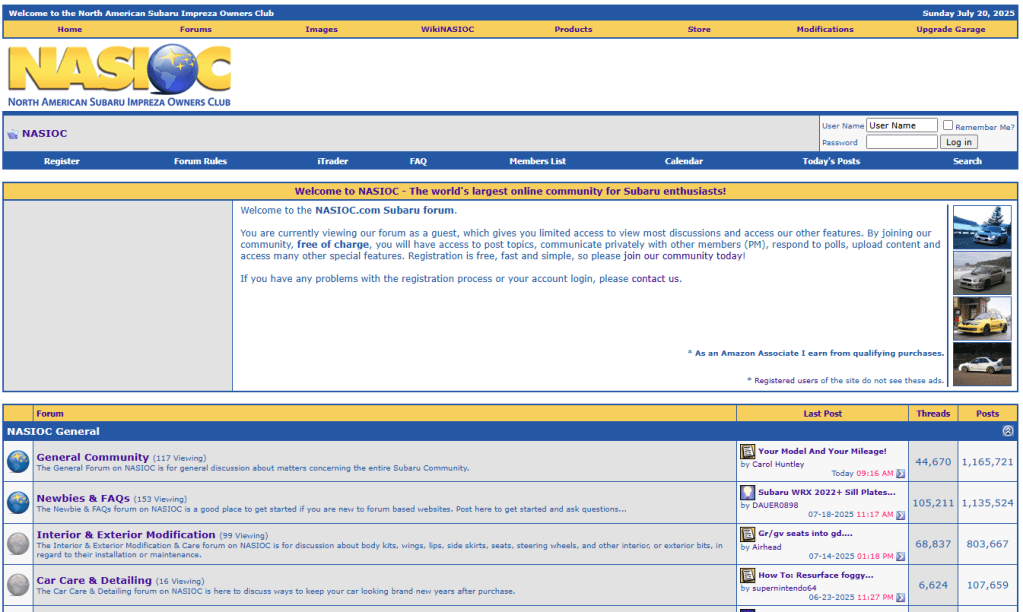
Back in the day, before Facebook and Google began their rule over the internet, there were message boards and forums. No matter what car you had, chances were, there was a message board for your make and model. And if you had a very popular model, it was likely a forum for just your chassis. As a Xennial, I used to cruise various forums of all kinds in the early 2000s, which was akin to channel surfing in the heyday of cable television in the 1990s.
During the chaos of 9/11, I spent half my time watching the footage on cable news, and the other half scrolling through message boards at work. The speculation was rampant and quickly turned conspiratorial. However, the boards were really the only place online that seemed to have any info at all. Granted, a lot of the information was bad info, but I wouldn’t figure that out until later.
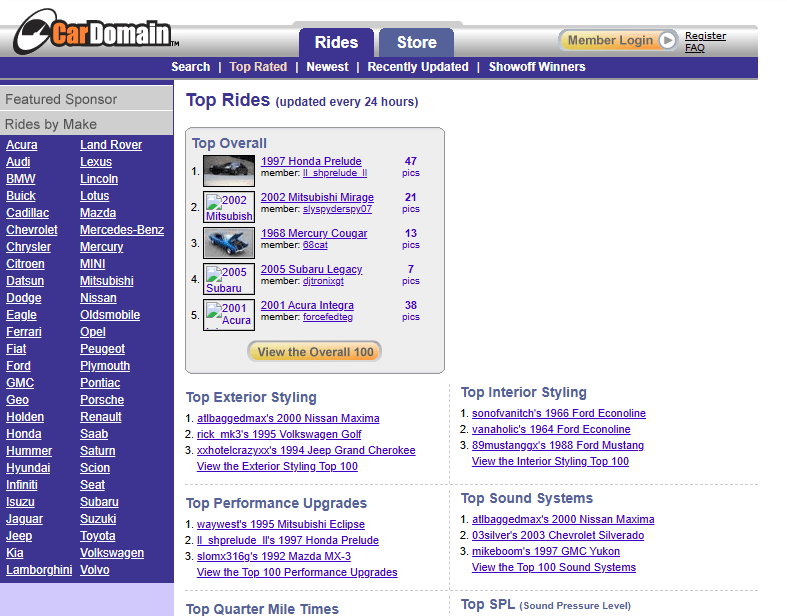
By the late 2000s, social media was in its infancy. In the 2000s, we basically had CarDomain and message boards. I was a broke 20-something, so all I could do was minor mods.
While there were many different message boards, I hung around the automotive forums. Overall, there were three types of automotive message boards: those narrowly focused on a specific chassis (e.g., Fox Body Mustangs), a general catch-all (e.g., Subaru), and location-specific boards.
The forums served several functions. One was a general discussion about your make and model. This is great for finding out basic information about one’s car free of charge. The other is DIY work, whether it be for maintenance, repairs, or modifications. There are the build threads that more or less serve as a blog for one’s own car. One of the main reasons I created this blog was to avoid the need to move my “build thread” should yet another forum collapse. And finally, there are the classifieds.
The larger message boards moved very quickly. An early morning post would be quickly buried by several pages of posts by the evening. This meant frequent monitoring and the bumping of posts back to the top so people could see them.
With the help of these boards, I learned how to work on my car, post by post. This, in turn, saved me potentially thousands of dollars over the years. Of course, I probably spent even more than I perhaps otherwise would have on modifications that I didn’t even know existed.
I was what was considered a “lurker” for most of my time on the forums. I had no money, very few tools, and little technical knowledge about cars, so I couldn’t really contribute to the discussions, and I remained on the sidelines. Also, taking a photo and uploading it was an ordeal in the early days of the internet. I remember buying a disposable camera, taking the photos, sending them off to get developed, and then scanning the hard copies to a hard drive. Then we needed to find an image host to upload them to, but more on problematic image hosting later.
Uploading images was made easier with cheap digital cameras and eventually, the ubiquitous cell phone. However, the exterior hosting of images was a persistent issue for new users to the forums, and over the long term, I believe this also hampered the forums’ greatest asset, their wealth of knowledge. Well-documented forum posts with detailed photos are made half as useful at best when the user relocates the images from one album to another, or a blog or image host becomes defunct. The interest is forever, at least until a server goes dark.
Automotive message boards had several design flaws, but none was more unsustainable than being subject to the whims of vehicle ownership. The more niche your car was, the greater the likelihood of your forum experiencing volatility in active membership. Many people buy their new and used cars, believing that they will own them forever. But after the miles rack up, and new makes and models are released, the flaws in the forever car become more apparent. This dynamic is also coupled with the various changes in one’s life. A marriage, a job in a new place, the birth of a child, or a medical emergency can change the need or affordability of any car at any given moment.
These original or current owners eventually turn the keys over to someone else and start a new automotive chapter on another message board. Even if users want to stick around the forum due to all of the relationships they’ve built, they eventually make fewer posts until they disappear for good. One of the worst things that can happen to an active message board is for a productive member to leave, taking their wealth of knowledge and experience with them. Their old posts will remain, but there is a low possibility of new questions being answered, and images associated with how-tos tend to disappear.
The new car owners are more likely to be younger, with far fewer resources at their disposal than the original owner. Many fresh-faced owners who sign up for the message boards are expecting to be greeted with open arms. They are wildly mistaken. Especially on the larger, more established forums, the tolerance for “newbs” was pretty low. These newbs who didn’t read the FAQs or didn’t use the search adequately are prime targets of the veteran trolls. Never mind the fact that one must learn the shorthand and nuance of a particular online community to use the search function well. Throw in spam mitigation strategies (limiting where and how new users can post, captcha on search functions), and the new user experience can be pretty overwhelming.
Add in the aspect that message boards are generally run by volunteer moderators who see the same or similar posts pop up daily, and it is easy to see how they would become frustrated with new users. If message boards were professional organizations, they would have a greeter or receptionist handle most new users. As these are the replacement members, without the new members, the forum growth will stall out and eventually decline due to the turnover of car ownership as models age. Typically, we see the smaller forums die first.
The location-specific forums were the most precarious to membership levels. Dividing a niche even further via geography does not bode well for long-term survival. They inherit all of the issues of a message board with a built-in, limited membership. Nearly all of the location-specific forums that I was a member of are now gone; some have been replaced with a Facebook group or a barely run Instagram account. Some of those members will move back to the larger forums or attempt to start a new forum, which usually fails. Others create Instagram accounts, YouTube channels, or WordPress blogs.
The splintering dynamic exists on Facebook Groups, as it is easier to break away and start a new FB Group than it is to create a new forum. Any perceived or real slight is grounds for breaking away to start a new FB group or subreddit. The inertia is rarely enough to sustain the new group.
Social media has become a replacement destination for most defunct message boards, even if Facebook and Reddit are poor substitutes. But the appeal of free internet hosting for the forum owner is probably a big draw. While researching a potential car purchase (don’t ask), I stumbled upon the message board, w8forum.dk, which was in the process of shutting down. Traffic was down for the forum that catered to the short-lived 2003-2005 VW Passat W8, and the owner was ready to move on. I browsed the forum for a while and downloaded a few pics here and there before I left. I attempted to return a few months later, only to find that it was finally gone.

Forums like w8forum.dk provide valuable information for an enthusiast researching a potential car purchase. Unlike with a YouTube video or blog review, you get the perspective of many different owners from a variety of backgrounds and skillsets. You can learn about the preferred vendors in the community and sometimes, the weaknesses of the model/chassis. You can also learn what parts of the service manual can be ignored or modified. Sometimes, the torque specs and fluid change intervals are wrong.
With message boards failing, the nuances of car ownership carry more risk. While cars are more reliable than ever, the information sphere that smoothed out the rough edges of ownership is becoming silos on Facebook Groups and YouTube channels. However, with Facebook, the silo is largely walled off to non-members, and for registered users, the relevant information gets buried by new layers of posts. This design pushes old info further underground each day, akin to a message board with no sub-forums. Or a Reddit with no Subreddits. Facebook is potentially deep with knowledge; nevertheless, that info is largely inaccessible, effectively making the medium perennially shallow by design.
However, before Facebook began its takeover of message boards, a short line of code probably turned more users away from the forums. Hampering its ability to remain a relevant destination for automotive information.
[img][/img]The Image Issue (Photobucket)
Once upon a time, Photobucket was the de facto image host for most users on automotive message boards. Founded in 2003, Photobucket was one of the more stable image hosts. Smaller hosts would come and go, or would delete your pics after a certain time (e.g., TinyPic). Flickr was nice, but getting the URL for your images was a tedious process. And frankly, I was too embarrassed about my low-quality images next to those of professional photographers. I wouldn’t touch a DSLR until 2012. Photobucket was the place for people like me.
As with most things on the internet, the free model is a difficult one to sustain without ads. Ad revenue rarely keeps pace with the costs of bandwidth and storage space. Most users don’t take these things into consideration. I know I didn’t. Eventually, Photobucket’s free model broke. To solve this problem, Photobucket decided to charge a crazy large fee for users to hotlink their images. They did so without warning, ironically kneecapping the forums when many of them were vulnerable. They eventually changed tactics slightly, but the damage was done. Many users moved to Imgur before they started blocking hotlinks. And in my opinion, users moved on to more image-friendly platforms like Instagram and Facebook.
It is becoming more and more common with each Google search that lead to an automotive forum post is usually missing the images that give it context. If you are lucky, there’s a cached, blurry version of its former self. Sometimes you can make out what you need, but most of the time you can’t. So you scroll and read through the comments, hoping that someone, anyone will describe in detail what that photo contained.
Images have long been an issue on the forums. Even today, people still have a hard time getting photos from their computers or phones into the forum post. Veteran forum users often get bent out of shape when a “noob” hasn’t figured out that one needs to find an image host first, then use the simplified but still “code” to get the image to appear in their post. And last but certainly not least, never ever change the location of that image.
Some forums include hosting, but many don’t. Those that do might require you to sign in or create an account before you can see anything other than a thumbnail. Unless you are desperate for the info, chances are you are going to move along. This happened to me. I was trying to compare EJ207 v7 (single-scroll) dyno graphs to EJ207 v8 (twin-scroll) graphs. I wasn’t really looking for peak numbers, I just wanted to compare the curves. It’s been long said on the forums that the EJ207 v8 spools like crazy. It is supposed to be epic. And yet, having been an owner of an EJ207 v8 for 6 years almost a decade, I can’t help but feel like this is just hopeful sentiment. Similar to idea that Japan has higher octane than US gasoline.
Rummaging through the Subaru-based forum, Nasioc, there are many posts that used to contain dyno graphs; presumably hosted on some long-dead image host. The ones that remain, at least, give you the stock “image no longer exists” image to let you know to keep on moving. This is obviously a fatal flaw in the long-term use of the message board model. Image hosts come and go, and newbies struggle to figure out how to get the images from their desktop to the website. And veteran users can’t be bothered to provide non-hostile solutions.
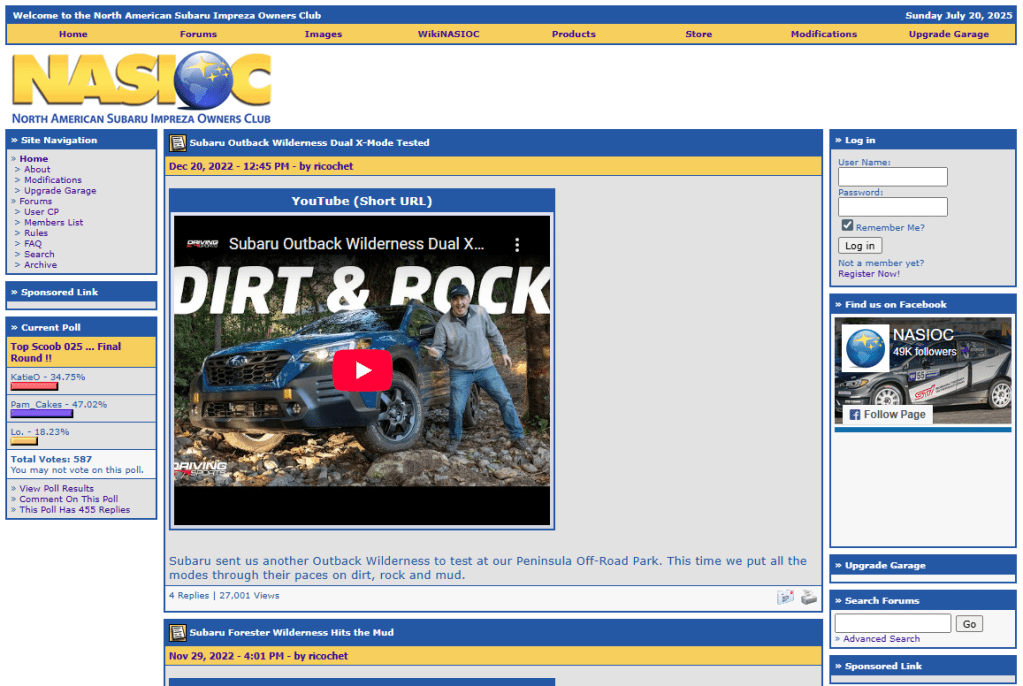
Around 2013, a local Subaru car club that I was a part of decided that it was time to break away from a regional subforum of Nasioc and start our own forum. We could make our own rules, and we would not have to worry about arbitrary rule enforcement on Nasioc. Ironically, we were ourselves, part of Nasioc’s decline. Many of us still used Nasioc to buy used car parts; however, as more time passed, more and more of these items were being listed on Facebook Marketplace. Even eBay and Craigslist are no longer viable options to buy and sell car parts. By 2016, the local forum was in trouble as well. And after some infighting and other internal issues, the club and the forum were dead by 2017.
A big problem with car forums is that once you sell your car, it becomes harder and harder to keep coming back. And slowly over time, former owners fade from view as they become more active in other car forums. Local forums are notoriously fickle to the winds of collective car ownership. As a new model is released, you can get a wave of new forum members, who are generally kept at arm’s length by the veteran users. And slowly, as the model gets older, the turnover begins.
And more users turn to social media instead of signing up for yet another forum. If you sell your car for another brand, you can just join another page on Facebook or follow another “page” on Instagram.
There are apps that tried to improve the mobile forum experience, and Tapatalk was probably the most popular among them. We could browse and post in most of the forums from a single app. Unfortunately, as with many apps born in the 2010s, they become buggy and stagnant over the years and eventually are more trouble than they are worth. Now, Tapatalk is that pop-up that you immediately close when you revisit a board.
Another problem with car forums or message boards, in general, is the newb/veteran problem. When I bought a new-to-me used car, or if I was researching a car, I would find a forum for that car, sign up, and as a responsible internet user, figure out how to use their janky search engine. Because heaven forbid if you ask a question that has already been answered, and you don’t already know their shorthand. Most people aren’t going to do that. After an encounter with the official forum troll, they will probably just give up and move on to social media.
Automotive Enthusiasm
Note: I wrote most of this section in 2022.
This brings us to automotive enthusiasm in general.
I began “driving” around the age of 15, and got my driver’s license at age 16. I wasn’t an automotive enthusiast until I started tinkering with my cars a few years later. This interest was largely driven by boredom. I was a poor kid in rural Alabama before the internet opened up the world to everyone with a phone line.
The first car I worked on was a 1984 Cadillac Eldorado that I bought from my grandfather for twelve hundred dollars. It was a very large two-door sedan that had a V8 that powered the front wheels. I believe it was the first fuel-injected car I owned, even though it looked like it had a carburetor on top. I basically painted any and every part I could remove from the engine bay, Ford Blue. I pulled the cylinder heads off to see what was inside, and that was the last time it ran. This is where reading the installation process would have saved me.
I eventually moved on to the Ford fox-chassis. I bought a 1985 Ford Thunderbird Turbo Coupe that had been swapped to a carb’d 302 and a C4 automatic. It wasn’t the car I wanted, but it was the car I could afford. It was basically a long Fox body Mustang. I put headers, exhaust, lowering springs, 5-lug conversion, and any Maximum Motorsports parts I could afford on it. It was loud as hell and slower than a Grand Prix GT, which I found out the hard way.

I had planned to do a manual swap and build the top end of the engine, but I never got around to it. The engine would randomly drop a cylinder, and I eventually pulled the heads to see if the pistons were shot. I accidentally put my hand on the cylinder #1 intake valve, and it compressed. It turned out to be a weak valve spring. Unfortunately, I was laid off around that time, so I couldn’t afford to fix it. My hope was to pick up a set of GT-40 iron heads, but they were always out of reach.
Then I moved to Michigan, and the car sat in my mom’s garage for years. I sold or gave parts to friends before eventually sending the chassis to the junkyard. I bought two more Turbo Coupes before moving on to an S197 Mustang, then a couple of rust buckets before picking up my first AWD car – a B5 Audi A4 Avant. The Audi was very expensive to maintain, so I sold it and bought my 2009 Subaru WRX.
Forums need members to function, yet they are or were hostile to new members. Car enthusiasts, in general, are on the decline as people have many options for their time. I am one of the few people in my very large extended family who even works on cars. I may be the only one who modifies them to this extent. Many people have stopped modding their cars and moved on to something else. Car enthusiasm, even amongst car enthusiasts, is dropping. Considering the money spent, I have considered leaving as well.
Most of my early cars were cheap, around the $1k – $2K range. Cars today are larger, more complicated, and more expensive than ever before. I paid $7k for my Bugeye, which was on the high side in 2016. And I had to drive it over 10 hrs home. Most people aren’t willing to jump through those kinds of hoops for a used car. If I lose my WRX, I’m not sure I will buy another car to modify. The supply of fun, affordable cars is dwindling, along with their aftermarket support. I am not interested in most modern cars. The GR Corolla has potential, but I don’t like what I am seeing with the engine issues. I rarely see GD-chassis cars on the road. On the occasion I do see a WRX or STI, it is usually a VA or VB chassis. The GRs seem to have completely disappeared as well, which is weird.
For sure, cars lose value as soon as they leave the lot; however, used cars seem to hold their value for much longer these days. Taking out a loan for a car and then immediately devaluing it with personalization is an unwise financial decision that many of us OG car enthusiasts continue to make.
According to cars101.com, my 2003 Subaru WRX had an MSRP of $24,820 when new. Adjusted for inflation, this is equivalent to around $40,293 today (2022). Even backing up to 2020 before the recent inflation spike would put it at around $36,174. I bought my 2009 WRX brand new in 2009 for around $25,000 ($30k in 2020 dollars). Had the WRX kept pace with the price of inflation, it would have listed at around $30k in 2009, well outside of my budget, which was maxed at $25k, and into entry-level luxury car territory. A 2022 WRX starts at around $29,105.
Buying a car at the top of your budget and then modifying or racing it is a tall order for most people. And yet, Subaru may be selling more WRXs and STIs than ever. Clean data is hard to come by, but Subaru seems to have sold around 30k VA chassis WRX/STIs a year. This is about 50% more than the GR chassis at about 15k a year. GD chassis data is notoriously difficult to come by, as Subaru grouped the Impreza, WRX, and STI trims together.
| Chassis | Total Sold | Avg/Yr Sold | Est. WRX/STI Only (Total) | Est. WRX/STI (Avg/Yr) |
| GD [source] | 214,889* | 35,982* | 119,818 | 19,970 |
| GR [source] | 394,580* | 56,369* | 85,396 | 12,200 |
| VA (WRX, STI) [source], | 161,188 | 26,865 | 161,188 | 26,865 |
Subaru sold an estimated 120k GD-chassis WRX/STIs, or an estimated average of almost 20k a year. This number is probably on the high side as I used an average of the WRX take rates of the Bugeye (the only ones available). People bought the Bugeye WRX just over half (about .555) more than the Impreza. The WRX/STI take rate drops to .223 for the GR-chassis, or around 12k a year. Nevertheless, the VA-chassis is the best-selling WRX/STI model to date, selling an average of nearly 27k cars per year. There should be, at least on paper, more Subie enthusiasts than ever. My hunch is that more people are buying WRXs, but they aren’t modifying them. Or they are very, very lightly modifying them.
Another argument for the decline in car enthusiasm is that cars are more difficult to modify. However, I personally think modifying cars is, in part, easier than ever. Tools are cheaper and more accessible. Not too long ago, I had plans to outfit my garage with pneumatic lines to run power tools. I had a compressor picked out. Then lithium power tools became very good, and I haven’t thought about a huge compressor since. One could also argue that there is more information available about many cars for free on blogs, forums, YouTube, and social media. You don’t have to buy a car magazine or repair manual to figure out how to repair or modify your car anymore. The main issue is finding the info. Cramped engine bays, on the other hand, do make mods or repairs more difficult. Some of these engineering decisions are pretty crazy! These days a laptop can modify many cars to solve a lot of OEM shortcomings.
My personal theory for the decline in car enthusiasm is likely the death of a thousand cuts. In general, people have more things to do with their time. I became a car enthusiast because I was bored out of my mind. I lived in the middle of nowhere, and one day I picked up a wrench. Prior to that, I didn’t like cars at all. If I had the internet back then, I am not so sure I would have started tinkering with my own car. Frankly, it wasn’t the wisest decision in the world. I can’t count how many times I made my car undriveable due to an ill-advised mod. That is less of an issue these days as I tend to take more strategic chances. However, your average person will shy away from ill-advised decisions on a perfectly running vehicle. Also, some car enthusiasts are assholes. And for better or worse, that can taint the image of the whole group. To be clear, most enthusiasts are pretty chill. But as a middle-aged man, I now understand why older gearheads tended to keep their heads down about younger car enthusiasts. You never know what you are going to get. Some people can’t take the hint of “no thanks”. My WRX attracts a lot of assholes who insist on a race when I am just trying to pick my kids up from school. I have strongly considered building a sleeper just to avoid the hassle (it is still on the table, TBH). Which sucks, because the GD-chassis WRX/STI is one of my favorite designs. Maybe I will paint my car white or gray to avoid sticking out. Once you add in the cost of the car, maintenance, and then mods, it becomes easier to see why car enthusiasm is at a low point.
While some will point to EVs killing car enthusiasm, I think this trend started long before EVs came on the scene. Japan had a pretty strong car scene in the 90s. Most of Japan’s cars are pretty boring these days. I think they are slightly ahead of us on the curve and give us a glimpse into the future. The 2000s seem to be the peak of performance cars in general, as there are only a handful of relatively affordable performance cars left. To be clear, these cars become more capable than ever. However, the price of that performance is out of reach for most enthusiasts. And used cars hold their value for much longer these days. With fewer enthusiasts, car forums will continue to become ghost towns.
Cheers!
P.S.
One thing I didn’t touch on is status. I think cars used to have higher status appeal for the average person when I was younger. In some circles, it still matters, but I don’t think most people care anymore. In other words, boasting about having the model with the most horsepower or the highest top speed is tacky these days. The bragging rights eventually shifted to having the fastest track times. Well, most people ain’t going to the track and don’t give a damn. Safety and gas mileage became more important issues as cars became just a means to get from A to B. Golden eras never last forever, and this era may end soon.


 b.obsdian | b.orginal
Leave a comment